
Planning · Construction · Installation
Your path to your own steam room
Are you planning a steam room or would you like to upgrade your shower into a steam shower? Here you will find answers regarding materials, waterproofing, steam generators, and maintenance – clearly explained and supplemented with practical videos.
Steam room construction in practice
An overview for planning your own steam room.
Insights into the setup and installation of steam room technology.
Construction and Waterproofing
Which materials are suitable for a steam room?
The entire structure must be suitable for high humidity, condensation, and the temperatures inside the steam room. Significantly higher temperatures occur near the steam outlet than in the rest of the room.
Suitable substrates include, for example, masonry, concrete, or appropriate construction boards. The key is a coordinated system consisting of substrate, thermal insulation, waterproofing, and surface finish. Have the manufacturer confirm the suitability of the materials used for steam room applications.
Benches can be made, for example, from suitable construction elements or aerated concrete, and then properly waterproofed and tiled.
How is a steam room waterproofed against moisture?
Walls, floors, and ceilings require a waterproofing system suitable for steam rooms. Corners, transitions, pipe penetrations, and the floor drain must also be integrated into the system.
Important: Waterproofing against liquid water does not automatically protect sufficiently against water vapor. Whether an additional vapor barrier is required depends on the wall and ceiling structure as well as the system being used. Commercially available liquid membranes are therefore not universally suitable for every steam room.
Tiles and silicone joints do not replace the underlying waterproofing. Use compatible system components and follow the manufacturer's processing guidelines.
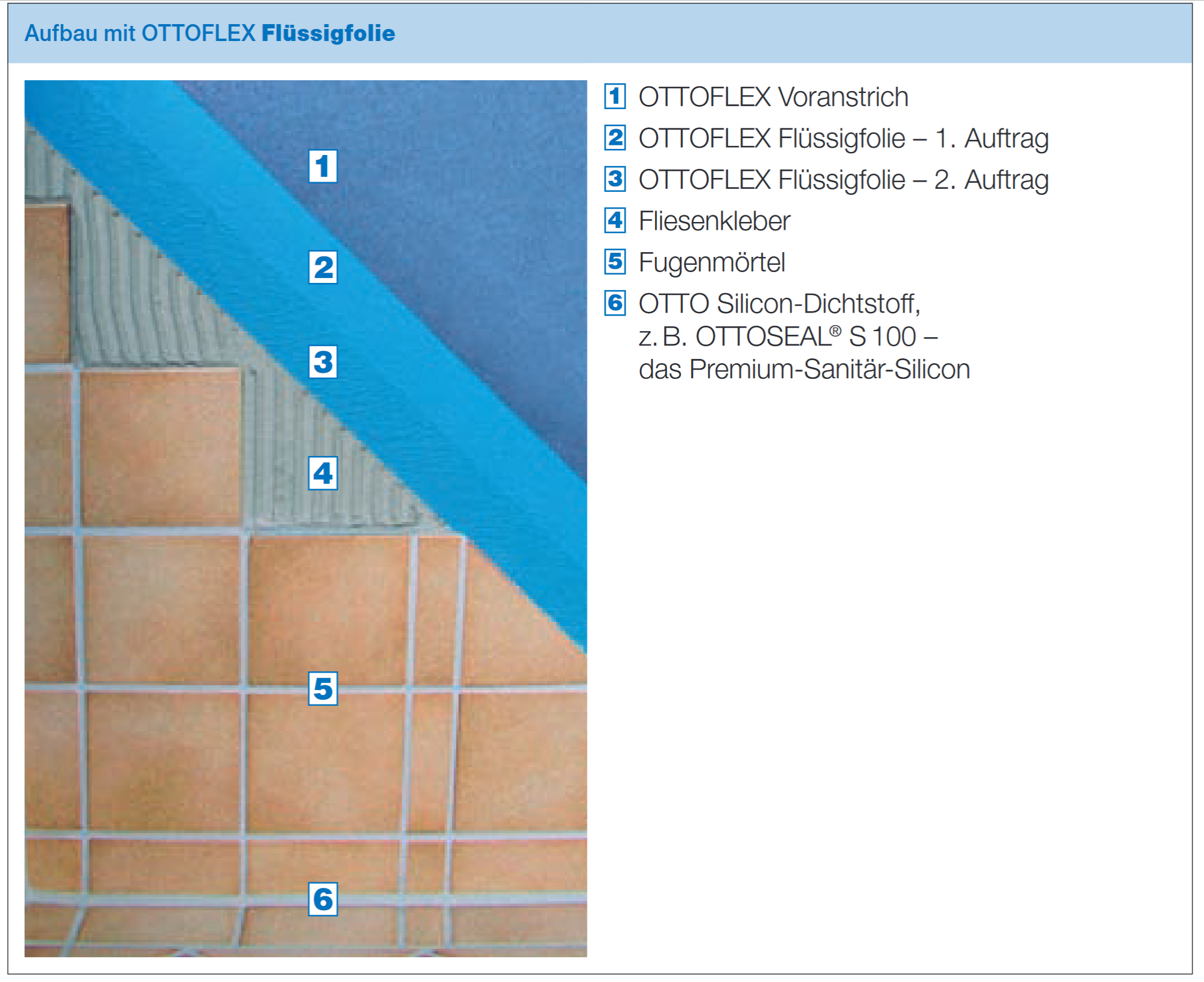
The following illustration provides guidance on the structure. The specific execution must be tailored to your project.
Does the ceiling need to be sloped or arched?
A sloped or arched ceiling can help drain condensation to the sides and reduce drops falling onto seating areas. A smooth surface supports the runoff.
How quickly drops form depends, among other things, on the surface temperature, insulation, and duration of use. Therefore, a fixed time limit cannot be stated generally. Adjust the shape and slope to the chosen construction system.
Why is thermal insulation useful?
Suitable thermal insulation reduces heat loss and can shorten heating time. Conversely, cold exterior walls, large glass areas, or massive surfaces increase heat demand.
A more powerful steam generator does not replace building-physically sound planning. Insulation and water vapor protection should be considered together.
What should be considered regarding the floor, tiles, and door?
- Floor: Choose a slip-resistant covering suitable for wet barefoot areas.
- Drain: Plan for a floor drain and an appropriate slope so that water can run off.
- Surfaces: Tiles, mosaic, adhesive, and grouting material must be suitable for the intended structure.
- Door: Use a safety glass door suitable for steam rooms. The air intake opening and door gap are adjusted to the ventilation concept.
Steam generator and installation
What power output does my steam room require?
First, calculate the room volume: Length × width × height.
1.60 m × 1.40 m × 2.30 m = approx. 5.15 m³
When selecting generator power, also factor in insulation, wall and ceiling materials, glass surfaces, and the starting temperature. The device size should therefore be selected based on the design specifications of the specific model.
Send us the internal dimensions and details of your cabin's construction. We will help you select a suitable steam generator.
How long does heating up take?
The heating time depends on the generator power, room size, starting temperature, and cabin construction. Well-insulated rooms generally heat up faster than cabins with cold, massive surfaces or large glass areas.
Plan for the desired heating time when selecting the generator. A binding minute count cannot be derived solely from the room volume.
Where can the steam generator be installed?
The steam generator is installed outside the steam cabin in a dry, sufficiently ventilated, and easily accessible location, such as a suitable utility room or ventilated cupboard.
Installation under a bench is only possible if the manufacturer's installation conditions are met. Ventilation, protection from moisture, and access for maintenance and repair must be ensured.
Installation position, clearances, permitted pipe lengths, and height differences are determined by the installation manual of the specific model.
Which connections are required?
- Cold water connection with drinking water quality
- Suitable sewage connection for draining and flushing
- Electrical connection matching the power output and the device model
- Steam line between the generator and steam outlet
- Cables for the control display and temperature sensor
Plan these connections before tiling the walls and seating areas. Electrical work must be performed by a qualified electrician; water and sewage connections must be carried out professionally.
How is the steam line installed?
The steam line must be suitable for the temperatures that occur. Depending on manufacturer specifications, copper or stainless steel pipes, for example, are suitable.
Lay the line as short as possible and ensure that condensation can drain in accordance with the installation manual. Avoid sags and water traps. Pipe diameter, slope, insulation, and maximum line length depend on the model.
Where are the steam outlet and temperature sensor installed?
Steam outlet: It is placed near the floor so that no one comes into direct contact with the escaping steam. Do not place it directly under a seat or in the immediate foot area. Observe the prescribed safety clearances and, if necessary, a contact guard.
Temperature sensor: Install it at the position specified by the manufacturer. Direct steam, doors, or ventilation openings can influence the measurement.
Please refer to your steam generator manual for the exact installation heights and clearances.
Can the control display be mounted outside?
Depending on the design, the control display can be mounted inside or outside the steam room. It is often easier to operate and read from the outside. The respective display must be explicitly suitable for interior installation.
Only use approved cable extensions. The sensor cable extension must also comply with the manufacturer's specifications.
Usage and Maintenance
What temperature is standard in a steam room?
Many steam rooms are used at around 40 to 45 °C and very high humidity. The appropriate setting depends on your personal preference and the device manufacturer's guidelines.
The room temperature should not be equated with the temperature at the steam outlet: there is a risk of scalding there.
Can I additionally heat seats or the floor?
Suitable seat, wall, or floor heating systems can increase comfort and preheat surfaces. The steam generator continues to handle steam generation.
Heating mats, controls, and installation must be suitable for the intended wet area and be coordinated with the waterproofing and surface structure.
How is the steam room ventilated after use?
After using the steam room, the cabin and the adjoining room must be able to dry sufficiently. Therefore, plan for appropriate ventilation during construction.
Whether window ventilation is sufficient or mechanical exhaust ventilation is required depends on the room size, usage, and structural conditions. A standard bathroom fan is not automatically suitable for hot, very humid air.
Squeegee water off the surfaces and ventilate until the moisture has dissipated sufficiently. A general duration of five or ten minutes does not apply to every steam room.
How do I prevent limescale deposits in the steam generator?
Limescale deposits depend primarily on water hardness and frequency of use. Regular descaling and the designated rinsing or drainage programs help to maintain the equipment.
In areas with hard water, appropriate water treatment may be useful. Whether a water softening system may be used and which water quality parameters are required depends on the generator manufacturer's specifications.
Use only suitable descaling agents and follow the maintenance instructions for your model.